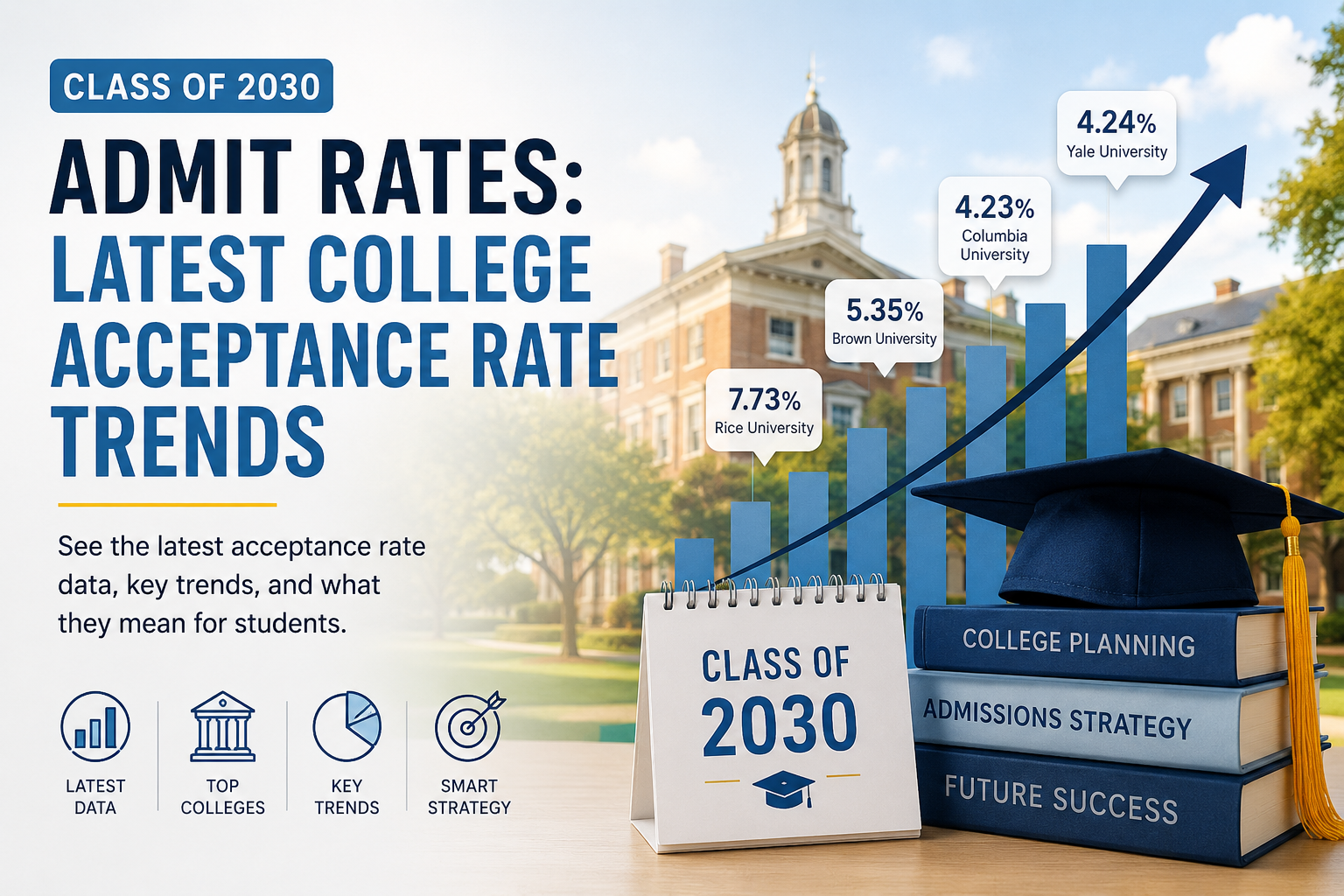
Class of 2030 Admit Rates
Overall admission rates for the class of 2030 are updated once information become available. Check back for updates as colleges continue to release data!
Note: “TBA” means the school has not yet released or confirmed the admit-rate data in this chart. Approximate rates are marked with “~.”
The college admissions landscape remains highly competitive for the Class of 2030.
As colleges continue releasing admissions data, early numbers show that many selective universities are maintaining historically low acceptance rates, while public universities continue to show major differences between in-state, out-of-state, and international applicants.
What Are Admit Rates?
A college’s admit rate, also called an acceptance rate, is the percentage of applicants who are offered admission.
For example, if a college receives 50,000 applications and admits 5,000 students, its admit rate is 10%.
However, admit rates do not tell the full story. Many colleges admit students through different rounds, including Early Decision, Early Action, Regular Decision, transfer admission, and special programs. Public universities may also have very different admit rates for in-state and out-of-state students.
Class of 2030 Admissions: Key Trends
The Class of 2030 admissions cycle shows that competition at top colleges remains intense. Several highly selective schools reported admit rates below 10%, including Brown, Columbia, Dartmouth, Duke, MIT, Vanderbilt, Williams, Amherst, Bowdoin, and Yale.
Some schools became even more selective compared with the previous year. For example, Columbia’s admit rate decreased from 4.94% for the Class of 2029 to 4.23% for the Class of 2030. Duke also dropped from 5.20% to 4.73%, while Vanderbilt declined from 5.33% to approximately 4.08%.
At the same time, not every school followed the same pattern. Some universities remained relatively stable, while others became slightly less selective. This shows why students should avoid relying only on national headlines and instead look carefully at each college’s individual data.
Highly Selective Colleges Remain Extremely Competitive
Many of the most selective colleges continue to admit only a small percentage of applicants. Current Class of 2030 admit rates include:
| School | Class of 2030 Admit Rate |
|---|---|
| Columbia University | 4.23% |
| Yale University | 4.24% |
| Massachusetts Institute of Technology | 4.58% |
| Duke University | 4.73% |
| Brown University | 5.35% |
| Dartmouth College | 5.84% |
| Bowdoin College | 6.53% |
| Amherst College | 6.78% |
| Williams College | 7.48% |
| Rice University | 7.73% |
| University of Notre Dame | 9.00% |
| Tufts University | 10.00% |
| University of Southern California | 11.67% |
| Boston College | 12.70% |
| Georgetown University | 13.00% |
These numbers make it clear that strong grades and test scores are only part of the admissions process. At highly selective schools, students also need strong essays, meaningful extracurricular involvement, academic focus, and a thoughtful college list.
Public University Admit Rates Can Vary by Residency
For many public universities, the overall acceptance rate does not tell the full story. In-state applicants often have a much higher admit rate than out-of-state or international applicants.
For example, Georgia Tech reported a Class of 2030 overall admit rate of 12.82%, but the in-state admit rate was approximately 27.64%, while the out-of-state and international admit rate was approximately 9.28%.
The University of Virginia also shows a major residency gap. For the Class of 2030, UVA reported:
| Applicant Type | Class of 2030 Admit Rate |
|---|---|
| In-state | 21.62% |
| Out-of-state and international | 9.61% |
This matters because many families look at a school’s overall admit rate and assume it applies equally to all applicants. In reality, a student’s residency status can significantly affect admissions chances at public universities.
Colleges With Notable Class of 2030 Admit Rates
Below are several schools that have already released Class of 2030 admit-rate data:
| School | Class of 2030 | Class of 2029 | Class of 2028 | Class of 2027 |
|---|---|---|---|---|
| Amherst College | 6.78% | 7.72% | 9.01% | 9.81% |
| Boston College | 12.70% | 13.85% | 16.19% | 15.65% |
| Bowdoin College | 6.53% | 6.81% | 7.13% | 8.02% |
| Brown University | 5.35% | 5.65% | 5.39% | 5.23% |
| Columbia University | 4.23% | 4.94% | 3.86% | 4.00% |
| Dartmouth College | 5.84% | 6.02% | 5.40% | 6.23% |
| Duke University | 4.73% | 5.20% | 5.71% | 6.78% |
| Georgetown University | 13.00% | 13.49% | 12.91% | 13.08% |
| Georgia Tech | 12.82% | 13.34% | 14.07% | 16.46% |
| Lafayette College | 32.27% | 31.16% | 31.45% | 31.40% |
| MIT | 4.58% | 4.56% | 4.55% | 4.80% |
| Rice University | 7.73% | 8.01% | 8.00% | 7.88% |
| Swarthmore College | 7.44% | 7.52% | 7.46% | 6.94% |
| Tufts University | 10.00% | 10.81% | 11.53% | 10.13% |
| Tulane University | ~15.00% | 14.46% | 13.98% | 14.59% |
| University of Notre Dame | 9.00% | 9.38% | 11.27% | 12.38% |
| University of Southern California | 11.67% | 11.19% | 9.81% | 10.01% |
| Vanderbilt University | ~4.08% | 5.33% | 5.86% | 6.28% |
| Wesleyan University | 15.78% | 16.11% | 16.49% | 17.10% |
| William & Mary | 34.43% | 36.96% | 34.09% | 32.72% |
| Williams College | 7.48% | 8.61% | 8.25% | 9.99% |
| Yale University | 4.24% | 4.75% | 3.87% | 4.50% |
Why Admit Rates Are Getting Lower at Many Colleges
There are several reasons why admit rates have become lower at many selective colleges.
First, many schools have received larger applicant pools in recent years. Test-optional policies, increased national awareness, and easier application platforms have encouraged more students to apply to more colleges.
Second, students are building longer college lists. Instead of applying to 6 or 8 schools, many competitive applicants now apply to 12, 15, or even 20 colleges.
Third, colleges are carefully managing yield, which means they are trying to predict how many admitted students will actually enroll. This can lead to more waitlist activity and more strategic admissions decisions.
Finally, top colleges are not just looking for qualified students. They are building a balanced class. Academic excellence matters, but so do essays, recommendations, extracurricular depth, institutional priorities, geographic diversity, major interest, and personal background.
What This Means for Students
For students applying to college, the most important takeaway is that admit rates should guide strategy, not create panic.
A low admit rate does not mean a student should avoid applying. However, it does mean students need a balanced college list with reach, target, and likely schools.
Students should also avoid assuming that past admission trends will perfectly predict future outcomes. A school that admitted 15% of applicants last year may become more selective this year depending on application volume, institutional goals, and yield management.
The strongest applicants usually have three things in common:
- They build a smart, balanced college list.
- They present a clear academic and personal story.
- They start early enough to create thoughtful applications.
How to Use This Class of 2030 Admit Rate List
Students and families can use this list to understand how competitive each college has been over the past several years. When comparing schools, pay attention to:
- Whether the admit rate is overall or separated by residency
- Whether the rate includes Early Decision, Early Action, and Regular Decision
- Whether the school has a special college, campus, or program with separate admission standards
- Whether the school’s admit rate has been rising, falling, or staying stable
For public universities, students should be especially careful with residency-based numbers. An out-of-state applicant may face a very different level of competition than an in-state applicant.
Final Thoughts
The Class of 2030 admissions cycle confirms that college admissions remains highly competitive, especially at selective private universities and popular public flagships. While admit rates are useful, they should not be the only factor students consider when building a college list.
A thoughtful application strategy should include academic fit, major availability, financial affordability, campus culture, location, and realistic admissions chances.
As more colleges release Class of 2030 data, this article will continue to be updated with the latest admit rates and admissions trends.