College Admissions
Colleges Reinstating SAT and ACT Requirements: What Students Should Know
After several years of test-optional admissions, more colleges are bringing back standardized testing requirements. For students applying in the coming admissions cycles, SAT and ACT planning is becoming important again.
The Return of Standardized Testing
During the COVID-19 pandemic, many colleges temporarily moved to test-optional admissions because students had limited access to SAT and ACT testing sites. Now, the admissions landscape is shifting again. While many colleges still remain test-optional, a growing number of selective institutions have announced that SAT or ACT scores will once again be required for admission.
This does not mean every college is bringing back testing. However, it does mean students should no longer assume that test-optional policies will stay the same from year to year. Testing policies can change quickly, and students should check each college’s official admissions website before applying.
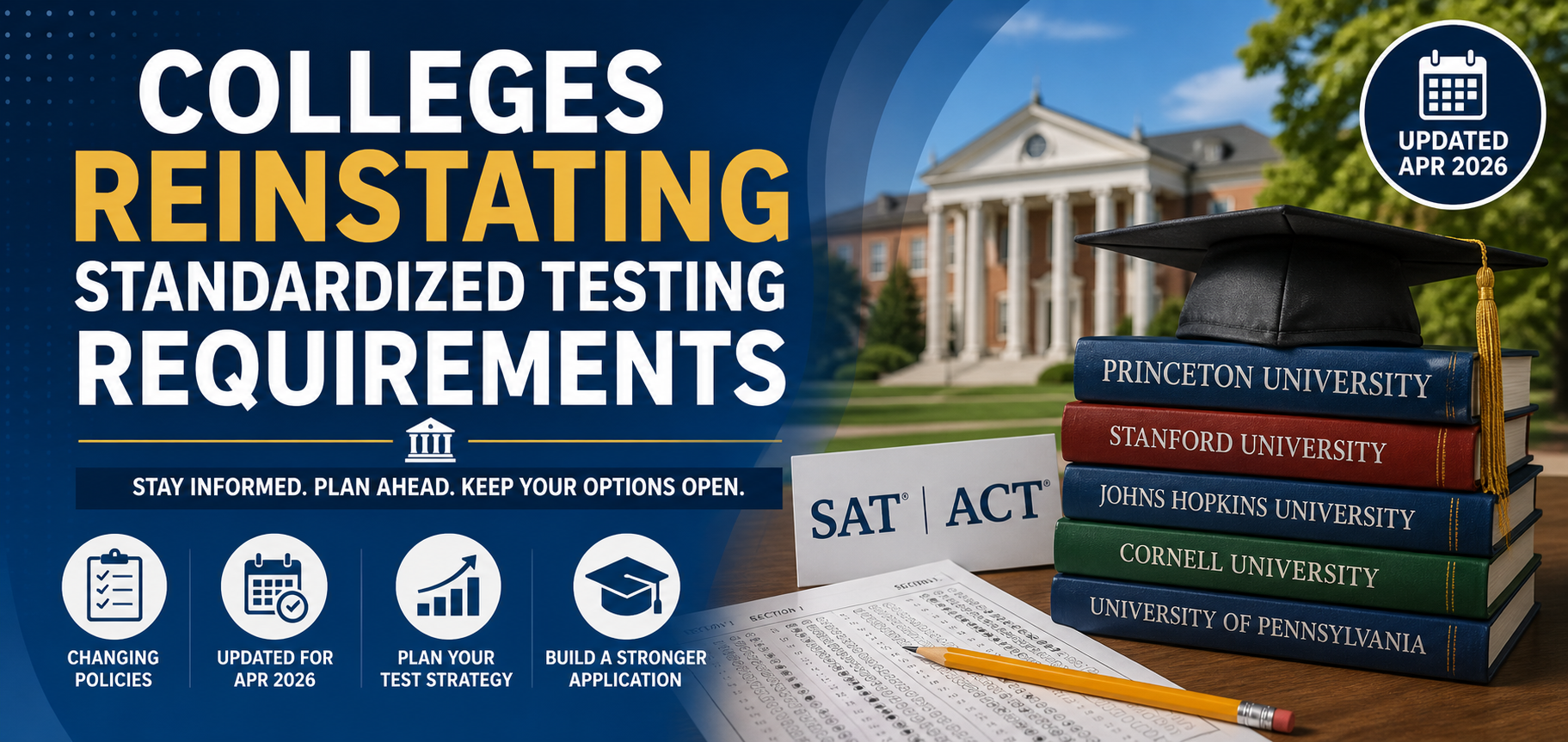
College Kickstart’s updated April 2026 list shows several institutions reinstating standardized testing requirements for recent and upcoming application cycles, including schools such as Princeton, Claremont McKenna, Carnegie Mellon, Cornell, Johns Hopkins, Stanford, University of Pennsylvania, and others. Source: College Kickstart
Why Are Some Colleges Bringing Back SAT and ACT Requirements?
Colleges have given different reasons for returning to standardized testing. Some institutions argue that test scores provide useful academic information when reviewed alongside grades, course rigor, essays, recommendations, and extracurricular activities. Others believe that standardized testing can help identify talented students from schools where fewer advanced courses or enrichment opportunities are available.
Johns Hopkins, for example, states on its admissions website that first-year applicants are required to submit SAT or ACT scores and that scores are reviewed as part of a holistic admissions process. Source: Johns Hopkins Undergraduate Admissions
This is part of a larger national trend. Harvard, Yale, Brown, Dartmouth, MIT, and other highly selective schools have also moved away from fully test-optional admissions in recent years, showing that standardized testing is becoming relevant again at many competitive colleges. Source: Associated Press
Colleges Reinstating Standardized Testing Requirements
The table below summarizes selected colleges that have reinstated or announced plans to reinstate SAT/ACT requirements. Students should always verify the latest policy directly through each college’s admissions website before applying.
| Institution | State | Admit Rate | Middle 50% SAT / ACT | Cycle Reinstated | Notes |
|---|---|---|---|---|---|
| Princeton University | NJ | 4% | 1500–1560 / 34–35 | 2027–28 | |
| Claremont McKenna College | CA | 9% | 1480–1540 / 33–35 | 2027–28 | |
| Auburn University | AL | 46% | 1260–1380 / 26–31 | 2026–27 | Test submission was already strongly encouraged. |
| University of Alabama | AL | 77% | 1110–1360 / 22–30 | 2026–27 | Phased return: GPA below 3.0 required first; universal requirement for Fall 2028. |
| Louisiana State University | LA | 73% | 1180–1320 / 24–30 | 2026–27 | Phased return: GPA below 3.5 required first; universal requirement for Fall 2028. |
| Carnegie Mellon University | PA | 11% | 1500–1560 / 34–36 | 2025–26 | Flexible policy; required for Computer Science; optional for Fine Arts. |
| Cornell University | NY | 8% | 1510–1560 / 33–35 | 2025–26 | |
| Georgia Southern University | GA | 88% | 970–1140 / 18–23 | 2025–26 | Part of the University System of Georgia’s shift. |
| Georgia State University | GA | 55% | 980–1200 / 19–26 | 2025–26 | Part of the University System of Georgia’s shift. |
| Johns Hopkins University | MD | 6% | 1530–1560 / 34–36 | 2025–26 | |
| Kennesaw State University | GA | 69% | 1010–1210 / 19–26 | 2025–26 | Part of the University System of Georgia’s shift. |
| Ohio State University | OH | 61% | 1280–1430 / 26–32 | 2025–26 | |
| Stanford University | CA | 4% | 1510–1570 / 34–35 | 2025–26 | |
| University of Miami | FL | 18% | 1350–1450 / 30–33 | 2025–26 | |
| University of Pennsylvania | PA | 5% | 1510–1570 / 34–36 | 2025–26 |
Note: This table is based on the College Kickstart April 2026 update and should be used as a starting point. Always confirm directly with each college because testing policies may change.
What This Means for Students Applying to College
Students should treat testing as part of their admissions strategy again. Even when a college is still test-optional, a strong SAT or ACT score can help support an application, especially at selective schools where many applicants already have strong grades and rigorous coursework.
This is especially important for students applying to competitive majors such as computer science, engineering, business, pre-med tracks, economics, and other high-demand programs. At some universities, admission to the major may be more selective than admission to the university overall.
Should Students Still Take the SAT or ACT?
In most cases, yes. Even if every school on a student’s current college list is test-optional, that list may change later. A student may add a college that requires testing, or a school may update its policy before the student applies.
Taking the SAT or ACT gives students more flexibility. If the score is strong, they can submit it. If the score does not help the application and the college is test-optional, they may choose not to submit it.
| Student Situation | Testing Recommendation |
|---|---|
| Applying to highly selective colleges | Plan to take the SAT or ACT. Strong scores may be expected or helpful. |
| Applying to schools that have reinstated testing | Testing is required, so students should prepare early. |
| Applying to test-optional colleges | Still consider testing. A strong score can improve the application. |
| Applying for merit scholarships | Check scholarship rules carefully. Some scholarships may still consider or require scores. |
| Unsure about college list | Take the SAT or ACT to keep more options open. |
Test-Optional Does Not Always Mean Test-Blind
One common misunderstanding is that “test-optional” means colleges ignore test scores. That is not true. Test-optional means students may choose whether to submit SAT or ACT scores. If students submit scores, colleges may still consider them as part of the application review.
Test-blind is different. A test-blind college does not consider SAT or ACT scores even if the student submits them. Because policies vary, students should carefully check whether a school is test-required, test-optional, test-flexible, or test-blind.
How to Build a Testing Plan
Students should begin by reviewing the testing policies for every college on their list. Then they should decide whether the SAT or ACT is a better fit. Some students perform better on the SAT, while others are stronger on the ACT.
A smart testing plan usually includes:
- Taking a diagnostic SAT and ACT to compare performance
- Choosing one test to focus on
- Preparing consistently for several months
- Taking the official test more than once if needed
- Checking score ranges for target colleges
- Reviewing whether scores are needed for scholarships or specific majors
When Should Students Start Preparing?
Students should avoid waiting until senior year to begin thinking about standardized testing. A good timeline is to take a diagnostic test during sophomore year or early junior year, prepare during junior year, and complete official testing before senior-year applications become overwhelming.
For students aiming at highly selective colleges, early planning matters. The strongest applicants often combine rigorous courses, strong grades, meaningful extracurricular involvement, thoughtful essays, and competitive test scores.
Final Takeaway
Standardized testing is not disappearing from college admissions. In fact, several selective colleges have already brought back SAT and ACT requirements, and more may follow. While test-optional admissions still exist at many schools, students should be careful not to assume that testing no longer matters.
The safest strategy is to prepare early, understand each college’s policy, and keep testing as an available option. A strong score can strengthen a college application, support scholarship opportunities, and give students more flexibility when building a balanced college list.
Leave a Reply