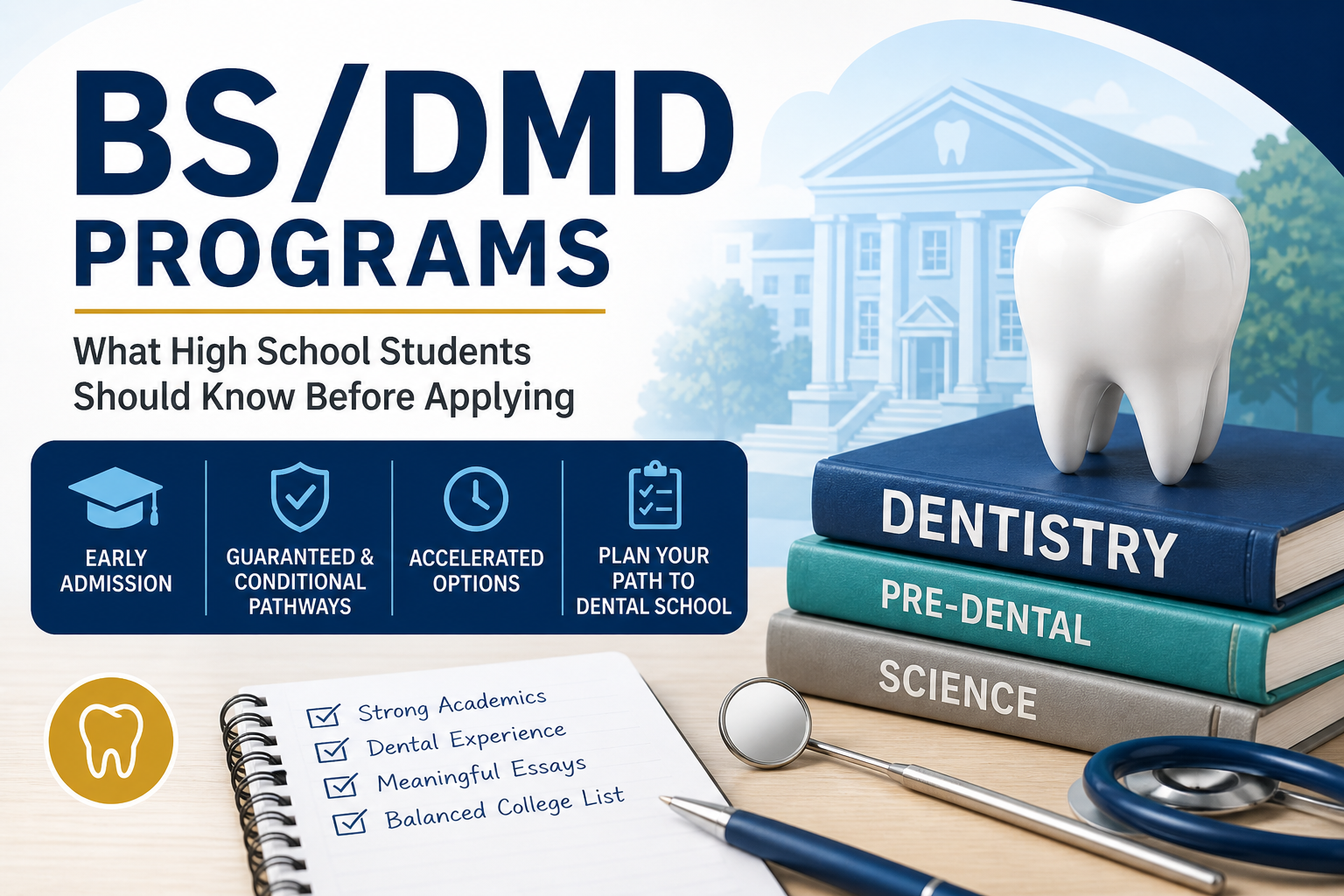
For students who are serious about becoming dentists, BS/DMD programs can be one of the most direct — and competitive — pathways into dental school.
These programs are especially attractive to students who already have a strong interest in dentistry, healthcare, science, patient care, and long-term professional school planning. However, they are also highly selective, and families should understand that applying to BS/DMD programs is not the same as applying to a regular biology or pre-health major.
What Does BS/DMD Mean?
BS/DMD stands for Bachelor of Science / Doctor of Dental Medicine. Some schools may use similar names such as BS/DDS, BA/DMD, or accelerated dental programs. The general idea is similar: students complete an undergraduate degree and then continue into dental school, often through a partner dental school or an affiliated dental program.
Traditional dental preparation usually involves four years of undergraduate study followed by four years of dental school. Some combined programs may shorten the overall timeline to seven years, while others may keep the traditional eight-year timeline but provide a more direct or conditionally guaranteed pathway.
Why BS/DMD Programs Are So Competitive
BS/DMD programs are competitive because they are not simply evaluating whether a student can succeed in college. They are also asking whether a high school student has the maturity, academic strength, service mindset, and professional clarity to eventually succeed in dental school.
Strong applicants usually need more than a high GPA. Competitive students often show evidence of:
- Advanced science coursework, especially biology and chemistry
- Strong standardized test scores, when required or submitted
- Dental shadowing or healthcare-related exposure
- Community service and patient-centered activities
- Leadership experience
- Clear motivation for dentistry
- Strong communication skills
- A thoughtful explanation of why dentistry is the right career path
This is why BS/DMD admissions should be treated as a specialized application strategy, not simply an extra box to check on the college list.
Common Requirements for BS/DMD Applicants
Each program has its own requirements, so students should always check the official admissions page for each school. However, many BS/DMD and accelerated dental programs may consider some combination of the following:
- High school transcript
- Rigorous coursework, including honors, AP, IB, or dual-enrollment science classes
- SAT or ACT scores, depending on the program’s testing policy
- Supplemental essays
- Dental or healthcare experience
- Letters of recommendation
- Interview performance
- Minimum college GPA requirements after enrollment
- DAT requirements for continuation, depending on the program
Students should also understand that acceptance into a BS/DMD program is often conditional. A student may need to maintain a specific GPA, complete prerequisite courses, demonstrate professionalism, and satisfy additional program requirements before officially entering dental school.
Important Dental School Prerequisites to Know Early
Even for students applying to combined dental pathways, the academic foundation matters. Dental schools commonly expect strong preparation in biology, general chemistry, organic chemistry, physics, and related lab sciences. Students who are serious about dentistry should begin planning their high school and college coursework early.
At the college level, many dental schools traditionally expect coursework such as:
- Biology with lab
- General chemistry with lab
- Organic chemistry with lab
- Physics with lab
- English or writing-intensive coursework
- Additional recommended courses such as biochemistry, anatomy, physiology, microbiology, or upper-level sciences
For high school students, this means the preparation starts long before the dental school application. Course selection, summer planning, volunteering, shadowing, and essay development should all support the same long-term story.
What Makes a Strong BS/DMD Essay?
A strong BS/DMD essay should not sound like a generic “I want to help people” essay. Admissions readers want to understand why the student is specifically interested in dentistry.
Strong essays often include:
- A specific moment that sparked the student’s interest in dentistry
- Evidence that the student understands the profession
- Reflection from shadowing, volunteering, research, or patient-facing experience
- A connection between science, service, communication, and manual skill
- A mature explanation of long-term goals
The best essays do not simply praise dentistry. They show that the student has explored the field carefully and understands both the rewards and responsibilities of the profession.
BS/DMD Strategy: Building the Right College List
Families should be careful not to build a college list only around BS/DMD programs. Because these programs are extremely selective, students should also apply to strong undergraduate colleges where they can succeed as pre-dental students even if they are not admitted to a direct dental pathway.
A balanced college list may include:
| Category | Purpose |
|---|---|
| BS/DMD or BS/DDS Programs | Highly selective direct or accelerated dental pathways |
| Strong Pre-Dental Colleges | Schools with strong science advising, research, and healthcare opportunities |
| Target Schools | Colleges where the student’s academic profile is competitive |
| Likely/Safety Schools | Schools with strong admission probability, affordability, and pre-health support |
The goal is not just to get into one program. The goal is to preserve multiple strong pathways toward dental school.
Common Mistakes Students Make When Applying to BS/DMD Programs
Many strong students hurt their chances by approaching BS/DMD applications too casually. Common mistakes include:
- Starting dental shadowing too late
- Writing essays that sound too general
- Applying without understanding each program’s continuation requirements
- Assuming high grades alone are enough
- Not preparing for interviews
- Building a college list with too many reach programs and not enough realistic options
- Failing to explain why dentistry, not just medicine or healthcare generally, is the right fit
BS/DMD admissions require early planning because the application must show consistency. A student’s classes, activities, essays, recommendations, and interview should all support the same professional direction.
Examples of BS/DMD, BS/DDS, and Direct Dental Programs
The following list includes examples of BS/DMD, BS/DDS, early assurance, guaranteed admission, conditional admission, and accelerated dental pathways. Program details can change, so students should always confirm the most current requirements directly with each college or dental school before applying.
Programs Commonly Open to High School Applicants
| Dental School / Program | Program Type | General Structure | Notes |
|---|---|---|---|
| Augusta University / Dental College of Georgia | BS/DMD pathway | 7-year program | Typically structured as 3 years of undergraduate study followed by 4 years of dental school. |
| Case Western Reserve University School of Dental Medicine | Guaranteed admission / articulation pathway | 6-year, 7-year, and 8-year options may be available | Includes pre-professional or articulation-style pathways with select undergraduate partners. |
| Howard University College of Dentistry | Combined education program | 6-year pathway | Often described as a 2+4 combined curriculum with conditional acceptance into the dental pathway. |
| Marquette University School of Dentistry | Pre-Dental Scholars Program | 7-year pathway | Conditional acceptance pathway for qualified students. |
| Missouri Southern State University / Kansas City University | Early acceptance program | 7-year pathway | Generally structured as 3 years at MSSU followed by 4 years at Kansas City University. |
| LECOM School of Dental Medicine | Early acceptance program | 8-year pathway | Partner undergraduate schools may include institutions such as Gannon University, Adelphi University, and Wisconsin Lutheran College. |
| Nova Southeastern University | Dual admission dental program | 7-year or 8-year pathway | Direct or dual admission style program for qualified applicants. |
| New York University College of Dentistry | Guaranteed admission pathway | 7-year pathway | May include pathways through NYU College of Arts and Science and partner institutions. |
| Rutgers School of Dental Medicine | Articulation agreements | Often 7-year pathways | Rutgers has had articulation agreements with multiple undergraduate colleges. Students should check each undergraduate partner for details. |
| Stony Brook University School of Dental Medicine | Scholars for Dental Medicine | 8-year conditional program | Designed for Stony Brook undergraduate students pursuing a conditional dental pathway. |
| Temple University Kornberg School of Dentistry | Conditional dental pathway | 7-year pathway | May include pathways with Penn State Erie, The Behrend College, and Temple University College of Science and Technology. |
| University of Connecticut Special Program in Dental Medicine | Special program in dental medicine | 8-year conditional pathway | Highly selective pathway for students interested in dental medicine. |
| University of Detroit Mercy School of Dentistry | Conditional dental program | 7-year pathway | Program may be connected to the McNichols Campus undergraduate pathway. |
| University of Illinois Chicago College of Dentistry | Conditional acceptance pathway | 8-year pathway | Admission or continuation may depend on undergraduate performance and program requirements. |
| University of Louisville School of Dentistry | ULEAD program | 8-year conditional pathway | Designed for University of Louisville students pursuing a dental school pathway. |
| University of Nevada, Reno / University of Nevada, Las Vegas | Conditional dental pathway | 7-year pathway | May be limited to Nevada high school graduates admitted to the University of Nevada, Reno. |
| University of the Pacific Arthur A. Dugoni School of Dentistry | Accelerated dental pathway | 5-year, 6-year, or 7-year options | Undergraduate study is generally completed at the Stockton campus, followed by dental study in San Francisco. |
| University of Pittsburgh School of Dental Medicine | Guaranteed admission program | 8-year pathway | Direct or guaranteed admission style dental medicine pathway for qualified students. |
| University of Pennsylvania School of Dental Medicine | Biodental program | 7-year conditional pathway | May include pathways with the University of Pennsylvania College of Arts and Sciences and select partner institutions such as Hampton University, Lehigh University, Muhlenberg College, and Villanova University. |
| Virginia Commonwealth University School of Dentistry | Guaranteed admission program | 8-year pathway | Dental school pathway for qualified students who meet continuation requirements. |
Programs Commonly Open to Current College Students
| Dental School / Program | Program Type | When Students Apply | Notes |
|---|---|---|---|
| Boston University Henry M. Goldman School of Dental Medicine | MMEDIC program | After approximately 2 years of study at Boston University | Modular Medical/Dental Integrated Curriculum pathway for qualified BU students. |
| Southern Illinois University School of Dental Medicine | Accelerated dental pathway | During undergraduate study | May be connected to Southern Illinois University Edwardsville and may have Illinois residency requirements. |
| Tufts University School of Dental Medicine | Early assurance program | As a Tufts college sophomore | Early assurance pathway for qualified Tufts undergraduate students. |
| University of Missouri-Kansas City School of Dentistry | DDS Reserved Admission Program | Sophomore year | May be limited to Missouri or Kansas residents. |
| University of Florida College of Dentistry | Honors combined BS/DMD program | Second semester freshman year | 7-year combined pathway for qualified University of Florida students. |
| Virginia Commonwealth University School of Dentistry | Preferred Applicant Track | During undergraduate study at VCU | Designed for qualified VCU Honors College students who entered as freshmen. |
Because program names, partner schools, eligibility rules, and application timelines can change, students should treat this table as a starting point for research. Before applying, confirm whether the program is open to high school seniors, current college students, state residents, honors students, or students at specific partner institutions.
How MMT Prep Helps BS/DMD Applicants
MMT Prep helps students build a clear and competitive BS/DMD admissions strategy. We work with students on academic planning, activity development, essay strategy, interview preparation, and college list building.
Our goal is to help students present a mature, well-supported application that explains not only that they are strong students, but also why they are ready to pursue dentistry as a long-term professional path.
For BS/DMD applicants, we can help with:
- College list strategy
- BS/DMD and BS/DDS program research
- Personal statement and supplemental essay planning
- Dental experience and activity positioning
- Interview preparation
- Pre-dental academic roadmap planning
- Application timeline management
Final Takeaway
BS/DMD programs can be an excellent opportunity for students who are deeply committed to dentistry, but they require thoughtful preparation. These programs are not simply looking for students who are good at science. They are looking for students who can demonstrate academic readiness, professional maturity, service orientation, and a clear understanding of the dental field.
Students who begin early, build meaningful dental-related experiences, and develop a balanced college strategy will be in a much stronger position.
If your student is interested in BS/DMD, BS/DDS, or other direct dental pathways, MMT Prep can help you create a focused admissions plan.
Contact MMT Prep at seank@mmtprep.com to learn more.
Leave a Reply